
DIY Diagnostic Guide: Zero Turn Mower Steering Problems Fix on a Viper
9 min read · 1762 words · Updated 2026-06-19
A zero turn mower steering problems fix on a Viper starts with the truth that there is no traditional steering box on the machine. Every Viper rider uses a Hydro-Gear hydrostatic transmission per side, with the V-400 Series on a ZT-2800, the V-600 Series on a ZT-3100 or ZT-3400, the V-800 Pro on a ZT-3800, the V-800 XP and ProStand XP on a ZT-4400, and the V-800 Elite on a ZT-5400. The lap bars drive those hydros, so any pulling, lag, or dead spot is almost always a transmission fluid issue, a tire pressure mismatch, a linkage adjustment, or a dampener problem, not a steering component.
If you searched for a zero turn mower steering problems fix on your Viper, the first thing to understand is that a zero-turn does not have a steering wheel, a steering box, a rack and pinion, or a tie rod end. There is nothing in the lineup that looks like the steering system on a car or a lawn tractor. Every Viper rider in the four-series lineup, which means the V-400 Series, V-600 Series, V-800 Series, and ProStand XP stand-on, uses two independent Hydro-Gear hydrostatic transmissions, one per rear wheel, and the lap bars are simply the operator controls that swashplate those hydros. When somebody says their zero-turn is pulling left, lagging on one side, or behaving sluggishly when they try to turn, what they are really describing is a hydrostatic imbalance, a tire issue, a linkage adjustment, or in some cases a dampener failure. A real zero turn mower steering problems fix means walking through the actual hydrostatic, mechanical, and tire systems on the machine in the order that gives you the highest probability of a fast resolution without throwing parts at the wrong problem. This guide does that walk in plain language, with Viper specifics where they exist and OEM service notes where they apply, so you can diagnose your machine instead of guessing.
Why a Zero Turn Mower Does Not Have a Steering System
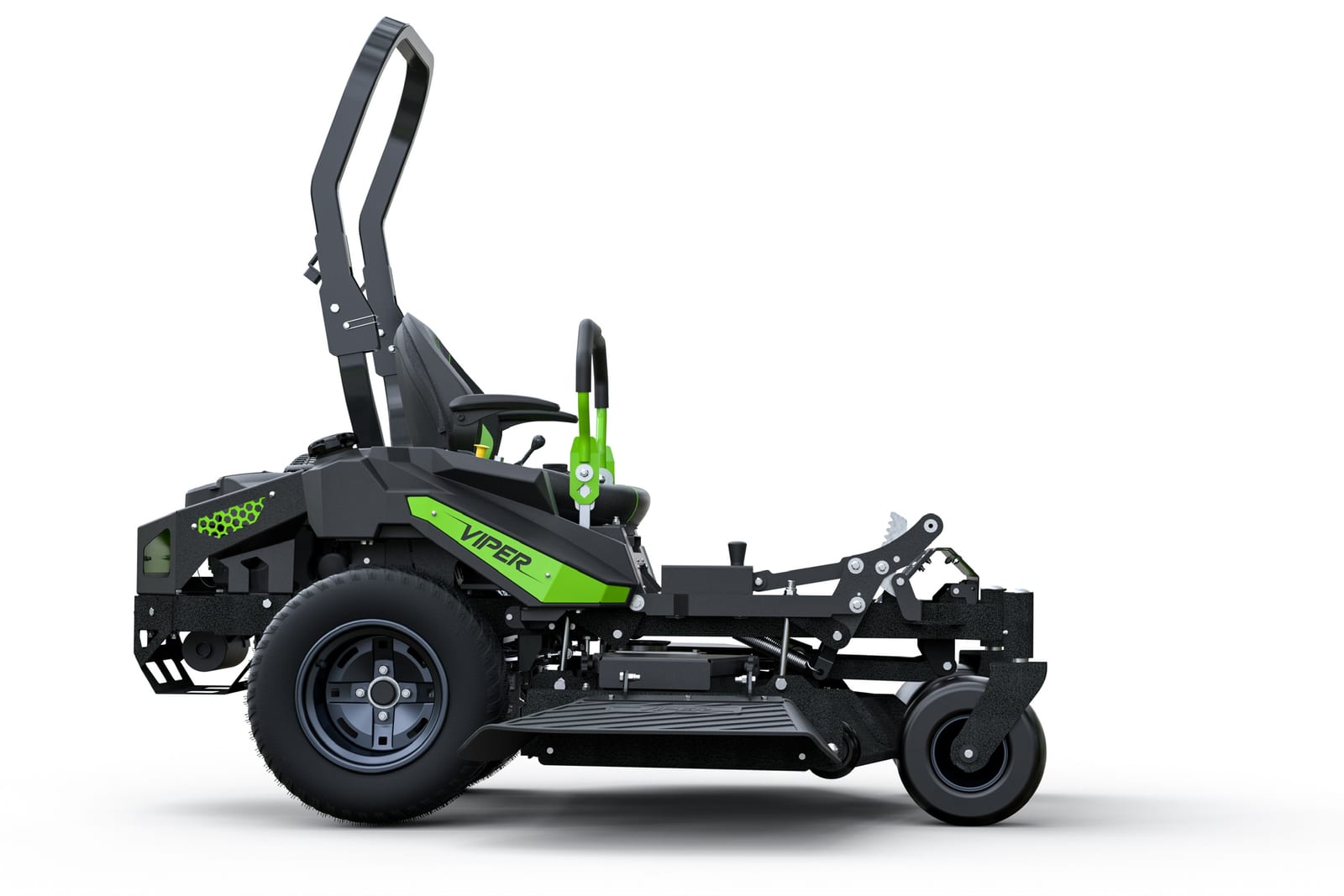
The first step in any zero turn mower steering problems fix is correcting the mental model. On a Viper V-400 Series, V-600 Series, V-800 Series, or ProStand XP, the rear wheels are each driven by their own independent Hydro-Gear integrated hydrostatic transmission. The V-400 Series uses a Hydro-Gear ZT-2800 with a charge pump and an overflow tank. The V-600 Series uses a Hydro-Gear ZT-3100 on one model variant and a Hydro-Gear ZT-3400 on the other. The V-800 Pro rides on a Hydro-Gear ZT-3800. The V-800 XP and the ProStand XP share the Hydro-Gear ZT-4400. The V-800 Elite gets the top-of-the-line Hydro-Gear ZT-5400. Each transmission contains a variable-displacement pump, a fixed-displacement motor, internal porting, and a final drive. Push the left lap bar forward and the left transmission swashplates open, sending fluid to the motor and spinning the left wheel forward. Pull the right lap bar back and the right transmission reverses flow and the right wheel turns backwards. That counter-rotation is what lets a zero-turn pivot on the spot. Because there is no steering linkage at all, every steering complaint on a Viper is really a complaint about one of three families of systems: the Hydro-Gear hydrostatic units themselves, the lap-bar linkage and dampeners that connect the operator to those units, or the rear and front tires that put the resulting motion on the ground. Diagnose in that order and you will solve almost every problem without parts darts.
Tire Pressure and Tread: The First Check on Any Pulling Problem
Before you touch a transmission or a linkage, check the tires. On a 60-inch V-800 Pro, the rear tires are 24 inch by 12 inch and the front tires are 13 inch by 6.5 inch solid. On a 60-inch V-800 XP or Elite, the rear tires are 26 inch by 14 inch and the fronts remain 13 inch by 6.5 inch solid. On a V-600 Series 60-inch V-600 Pro, the rear tires are 22 inch by 12 inch, and on the V-600 Series 60-inch V-600 XP the rear tires are 24 inch by 12 inch. The V-400 Series in its 52-inch configuration runs 22 inch by 9.5 inch rear tires and 13 inch by 5 inch fronts. The ProStand XP 60-inch rear tires are 24 inch by 14 inch with 13 inch by 6.5 inch solid fronts. A pneumatic rear tire that is even a couple of PSI low compared to its mate will roll at a slightly smaller effective diameter and will let the machine drift toward that side under load. Always check pressure cold with a calibrated gauge, set both rear tires to the same value within the operator manual sidewall range, and inspect the tread for uneven wear, exposed plies, or chunked rubber. Solid front tires cannot lose pressure but they can develop flat spots from being parked in one position for long periods, and a flat-spotted front caster will track funny until it rolls out. If both rears are equal and the tread looks healthy, you can move on to the lap-bar linkage and the hydrostatics with confidence that you are not chasing a phantom transmission problem caused by a tire that needs three pumps of air.

Lap-Bar Neutral, Tracking, and Dampener Diagnosis
The next stage in a zero turn mower steering problems fix is the lap-bar linkage. On a zero-turn like a Viper, the lap bars typically connect through a series of rods and a dampener to the swashplate control arm on each Hydro-Gear transmission. There are three things that go wrong here in the real world. The first is neutral position. Each lap bar must center in true hydraulic neutral when released, with the parking brake disengaged and the engine running, so that the machine does not creep forward or backward on a level surface. If one side creeps, the linkage to that side is out of neutral and needs adjustment per the procedure in your operator manual. The second is tracking. Both lap bars, when pushed fully forward to the same stop, should produce equal forward speed so the machine tracks straight under full throttle. If the machine drifts one way at full forward, after you have ruled out tire pressure, the tracking adjustment on the slow side needs to come up to match the fast side. The third is the dampener. Most zero-turn lap bars use a hydraulic dampener that smooths input and returns the bar gently to neutral. A worn dampener typically feels like a lap bar that flops freely, returns too fast, or makes the machine feel jumpy and twitchy in turns. Dampeners are generally wear items and are typically replaceable. If your machine has gone from smooth to harsh without any other change, it is worth suspecting the dampeners before the transmissions, since on most machines they are far cheaper and far easier to swap out than a hydrostatic unit; confirm the specific part and procedure with your Viper dealer.
Hydro-Gear Fluid, Filter, and the Real Service Spec
Once tires and linkage are clean, the next layer of a zero turn mower steering problems fix is the Hydro-Gear hydrostatic transmission itself. Lag, weakness on hills, loss of top speed on one side, jerky response, or a whining noise from the transmission area all point to the hydros, and almost all of them resolve to a fluid and filter problem. Per Hydro-Gear service literature, the ZT-2800, ZT-3100, ZT-3400, ZT-3800, ZT-4400, and ZT-5400 used across the Viper lineup all take 20W-50 engine oil with an API SL classification, minimum 9.0 cSt at 230 degrees Fahrenheit. That is not ISO 46, not ISO 32, not ISO 68, and not any other ISO hydraulic fluid. ISO hydraulic oils are a different product class and do not belong in a Hydro-Gear ZT-series unit. Per Hydro-Gear, the initial fluid and filter change is at 75 to 100 hours on the smaller ZT-2800 through ZT-3800 and at 100 hours on the larger ZT-4400 and ZT-5400, and every change after that is every 400 hours. The matched Hydro-Gear service kit, part number 72750 for the smaller units or 72881 for the larger ones, contains the correct fluid and filter together. If your machine has never seen its break-in service, or it has gone well past 400 hours since the last one, the fluid is almost certainly degraded and you will see steering symptoms long before you see a hard failure. Drain, refill with 20W-50 API SL, replace the filter, and bleed the system per the Hydro-Gear procedure with the rear wheels lifted and the drive levers cycled through their range to purge air. Recheck the level and log the service against your hour meter. A surprising percentage of steering complaints disappear on the spot after a correct fluid and filter service.

When to Stop DIY and Call Your Dealer
A do-it-yourself zero turn mower steering problems fix has limits, and knowing where those limits are will save you money and downtime. If you have already checked tire pressure and tread, confirmed both lap bars sit in true neutral, verified the tracking adjustment matches at full forward, replaced or inspected the dampeners, and performed a clean fluid and filter service on the Hydro-Gear transmissions with the correct 20W-50 API SL oil, and the machine is still pulling, lagging, whining, or behaving inconsistently in turns, the next step is professional diagnosis. Internal pump or motor wear inside a ZT-series unit is not a homeowner repair. It typically involves pressure testing, internal inspection, and parts that are not commonly stocked at a retail level. Catastrophic linkage damage, a bent control arm from an impact, or a cracked transmission housing also belong on a lift in a service bay. Viper covers the engine and Hydro-Gear components under the 3-year portion of its 4-3-2 warranty structure, with unlimited hours during the first 2 years, exclusions apply, so if your machine is within those windows it is worth a dealer visit before you spend any more time chasing the problem yourself. Distribution is currently dealer-application only, with no public dealer locator on the Viper Mowers site, so your starting point for any warranty conversation is the dealer you bought the machine from or the Viper Mowers contact line at 941-340-2675.
Frequently Asked Questions
A real zero turn mower steering problems fix on a Viper is not about hunting for a steering box that does not exist. It is about diagnosing the Hydro-Gear hydrostatic transmissions, the lap-bar linkage and dampeners, and the rear and front tires in the right order. Start with tire pressure on the V-400 Series, V-600 Series, V-800 Series, or ProStand XP, because most pulling complaints end there. Move to lap-bar neutral, tracking, and dampener condition, because a worn or misadjusted linkage will mimic transmission problems for free. Then service the Hydro-Gear ZT-2800, ZT-3100, ZT-3400, ZT-3800, ZT-4400, or ZT-5400 with the correct 20W-50 API SL engine oil, never an ISO hydraulic fluid, at the published break-in interval (75 to 100 hours on the smaller units, 100 hours on the larger) and every 400 hour interval per Hydro-Gear. Use part 72750 (smaller units) or 72881 (larger units) if you want the fluid and filter in one box. If symptoms persist after all of that, get the machine to your Viper dealer while the 4-3-2 warranty is still on your side. Diagnose in the right order, respect the published specs, and you will fix more steering complaints in an afternoon than most owners fix in a season.
Ready for a Machine Built to Last?
Explore the Viper Mowers commercial zero-turn lineup on vipermowers.com and find the series that fits your property:
See the Full Lineup →Published: 2026-06-19