

Zero Turn Mower Hydraulic Transmission Service on a Viper
12 min read · 2448 words · Updated 2026-06-19
The zero turn mower hydraulic transmission on every Viper rider and the ProStand XP is a Hydro-Gear ZT-series integrated hydrostatic drive. Viper uses the Hydro-Gear ZT-2800 on the V-400 Series, the ZT-3100 on V-600 Pro, the ZT-3400 on V-600 XP, the ZT-3800 on the V-800 Pro, the ZT-4400 on the V-800 XP and the ProStand XP, and the ZT-5400 on the V-800 Elite. Per Hydro-Gear's service literature, every one of those units takes 20W-50 engine oil with an API SL classification, with an initial fluid and filter change (75 to 100 hours on the smaller ZT-2800 through ZT-3800, 100 hours on the larger ZT-4400 and ZT-5400) and every 400 hours thereafter. Hydro-Gear sells the matched parts as a service kit: part #72750 for the ZT-2800 through ZT-3800 and part #72881 for the ZT-4400 and ZT-5400.
The zero turn mower hydraulic transmission is the part of a commercial mower that most owners never think about until something goes wrong, at which point they suddenly care very deeply. On a Viper zero-turn, the transmission is not a mystery box. Every machine in the lineup uses a Hydro-Gear ZT-series integrated hydrostatic drive, a published, well-documented product family with clear fluid specifications and a clear service interval from the manufacturer. The V-400 Series runs a Hydro-Gear ZT-2800 with a charge pump and an overflow tank. V-600 Pro runs a Hydro-Gear ZT-3100, and V-600 XP runs a Hydro-Gear ZT-3400. The V-800 Pro runs a Hydro-Gear ZT-3800. The V-800 XP and the ProStand XP both run a Hydro-Gear ZT-4400. The V-800 Elite gets the top-of-the-lineup Hydro-Gear ZT-5400. This guide walks through how the zero turn mower hydraulic transmission actually works, what fluid Hydro-Gear specifies, exactly how often to service it, and how to perform the work without getting tripped up by bad internet advice about ISO hydraulic fluids that do not belong anywhere near a Viper. The numbers here trace to Hydro-Gear's published service literature, not to a Viper marketing page, because Viper does not publish a maintenance schedule and Hydro-Gear is the correct authority.
How a Hydro-Gear ZT-series hydraulic transmission actually works
A Hydro-Gear ZT-series unit is an integrated hydrostatic transmission, meaning it packages a variable-displacement hydraulic pump and a fixed-displacement hydraulic motor together inside a single sealed housing along with a reservoir, a filter, the gear reduction, and the output shaft that drives the wheel. On the Hydro-Gear ZT-2800 fitted to the V-400 Series, a charge pump and overflow tank are included as part of the design. When you push the lap bar forward, you swashplate the pump inside the housing, which pushes fluid against the motor, which spins the output shaft, which drives the rear wheel on that side of the machine. Pull the lap bar back and the pump swashplates the other way, so the same wheel turns backward. Each side of a Viper zero-turn has its own independent Hydro-Gear unit, which is why the machine can counter-rotate its wheels and pivot in place. There is no mechanical clutch, no shift lever, and no traditional transmission gear set. Everything that drives a Viper forward, backward, or around a tree comes from hydraulic flow being modulated by the operator's lap bar position. That is also why the fluid inside the unit is not optional and not interchangeable. The pump and motor live in pressurized oil at high temperature; the fluid is what lubricates the rotating group, dissipates heat, and seals the running clearances. Get the fluid wrong and the unit cavitates, loses pressure, runs hot, and slowly cooks itself. Get the fluid right and a Hydro-Gear ZT-series unit will last a very long time under commercial duty.
Which Hydro-Gear ZT model is in your Viper
Viper uses six different Hydro-Gear ZT-series models across the lineup, and the right one is dictated by which machine you bought. The V-400 Series ships with a Hydro-Gear ZT-2800 with a charge pump and overflow tank, which is documented on the V-400 Series product page as part of the standard spec. V-600 Pro ships with a Hydro-Gear ZT-3100; V-600 XP ships with a Hydro-Gear ZT-3400. The two V-600 Series models are distinguished by the spec block on the V-600 Series product page, with V-600 Pro paired to the Kawasaki FR730 24 HP engine and V-600 XP paired to the Kawasaki FT730 24 HP engine. On the V-800 Pro, the entry trim of the three V-800 Series models, you get a Hydro-Gear ZT-3800. Step up to the V-800 XP and you get a Hydro-Gear ZT-4400, which is the same ZT-4400 fitted to the ProStand XP stand-on. At the top of the lineup, the V-800 Elite runs the Hydro-Gear ZT-5400. The simplest way to confirm which ZT model lives under your seat is to read the spec sheet that shipped with your machine, or pull the cover on the transmission housing and read the Hydro-Gear casting numbers. The reason the model number matters is that Hydro-Gear documents the same fluid and a similar change cadence across the ZT-2800, ZT-3100, ZT-3400, ZT-3800, ZT-4400, and ZT-5400, but the service kit splits by size: per Hydro-Gear, kit #72750 covers the smaller ZT-2800 through ZT-3800, while kit #72881 covers the larger ZT-4400 and ZT-5400. So while the displacement and the torque rating climb as you move up the ladder, the maintenance procedure barely changes. That is good news for a fleet operator running a mix of V-400 Series, V-600 Series, V-800 Series, and ProStand units: one service procedure covers every transmission in the yard.
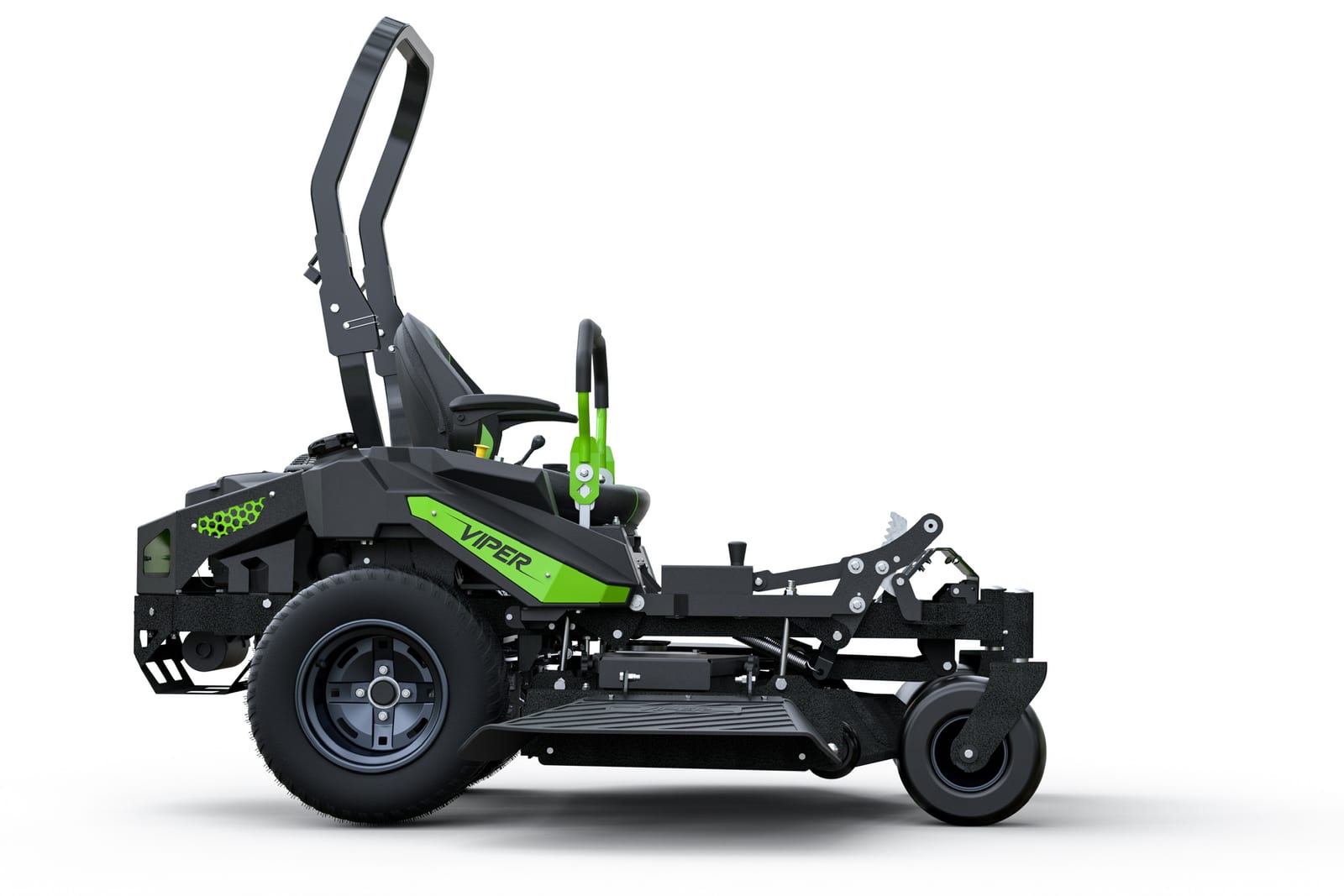
The correct fluid: 20W-50 engine oil, API SL, not ISO hydraulic fluid
This is the part of the job that people get wrong, and getting it wrong is what kills a Hydro-Gear unit. Per Hydro-Gear's service literature, every Hydro-Gear ZT-series integrated transmission on the Viper lineup, the ZT-2800, ZT-3100, ZT-3400, ZT-3800, ZT-4400, and ZT-5400, takes 20W-50 engine oil with an API SL classification. Hydro-Gear specifies a minimum viscosity of 9.0 cSt (55 SUS) at 230 degrees Fahrenheit, which is what a standard 20W-50 engine oil delivers across the operating temperature range of a commercial mower transmission. Note what that does not say. Hydro-Gear does not specify an ISO 32 hydraulic fluid. Hydro-Gear does not specify an ISO 46 hydraulic fluid. Hydro-Gear does not specify an ISO 68 hydraulic fluid. Generic ISO-grade hydraulic fluids are the wrong product class for a Hydro-Gear ZT-series unit because their additive packages are formulated for industrial hydraulic systems, not for an integrated hydrostatic transmission that lives inside a sealed lawn equipment housing alongside a wet brake and a charge circuit. If you walk into a parts counter and someone hands you a quart of ISO 46, hand it back. The correct purchase is a quart or two of 20W-50 engine oil, API SL classification, from a mainstream engine oil maker. If you prefer to buy the matched service parts from Hydro-Gear directly, the kit depends on your unit: Hydro-Gear part #72750 for the smaller ZT-2800 through ZT-3800, and part #72881 for the larger ZT-4400 and ZT-5400. Either kit packages the correct filter and the correct fluid in one box so there is no guessing at the parts counter. That kit is the simplest insurance policy you can buy on a Hydro-Gear ZT-series unit.
Service intervals per Hydro-Gear: 75 to 100 hours, then every 400
Per Hydro-Gear's service literature, the initial fluid and filter change on the smaller Hydro-Gear ZT-series units, the ZT-2800 on the V-400 Series, the ZT-3100 and ZT-3400 on the V-600 Series, and the ZT-3800 on the V-800 Pro, happens at 75 to 100 hours of operation; on the larger units, the ZT-4400 on the V-800 XP and the ProStand XP and the ZT-5400 on the V-800 Elite, Hydro-Gear specifies the initial change at 100 hours. After that initial break-in service, Hydro-Gear specifies a fluid and filter change every 400 hours of operation (or yearly on the larger units) for the life of the unit. Note how that differs from the engine schedule. Per Kawasaki's service manual, the engine on a Viper takes an oil change every 100 hours; per Vanguard's service literature, the Vanguard alternative engines also take an oil change every 100 hours. The transmission interval is four times longer than the engine interval on every Viper in the lineup. In practical terms, that means a commercial cutter running twenty to thirty hours a week hits the engine oil change every three to five weeks but only hits the transmission change every three to four months in peak season. A one-acre homeowner running maybe eighty to a hundred hours a year hits the transmission interval once every four to five seasons. Track hours from the dash hour meter, not from the calendar. If the meter says 380 hours since your last transmission service, you have twenty hours left before the next one is due. If the meter says 410 hours, you are already overdue. There is no padding in this number; Hydro-Gear specifies 400 hours, so 400 hours is the line.

Performing the service: step-by-step on any Viper ZT-series unit
Start by warming the machine up with a five-minute idle run, then bring it back to a level concrete pad or shop floor. The fluid drains and refills better warm, and a level surface is non-negotiable for getting the fill level right. Shut the engine off, set the parking brake integrated into the drive handles, and pull the spark plug wires so the engine cannot fire accidentally during the service. Chock the front tires. Get under the machine with a drain pan rated for at least two quarts per transmission, since each Hydro-Gear ZT-series unit drains independently. Locate the drain plug on the Hydro-Gear housing; on most ZT-series units it is a hex-head plug at the lowest point of the case. Remove the plug and let the unit drain completely, which usually takes five to ten minutes. While it drains, locate the spin-on filter and break it loose with a filter wrench. Expect residual fluid; have rags ready. Wipe the filter base clean, rub a thin film of fresh 20W-50 on the new filter's gasket, spin the new filter on by hand until it seats, and tighten it three-quarters of a turn past contact. Do not use a wrench to over-torque a spin-on filter. Reinstall the drain plug to the spec in the Hydro-Gear service literature for your ZT model. Refill the unit through the top fill plug with 20W-50 engine oil, API SL classification, up to the fill mark on the reservoir. Reinstall the cap. Repeat the procedure for the second transmission on the opposite side. After both units are refilled, the Hydro-Gear service literature calls for a purge procedure: with the rear of the machine elevated, run the engine at idle and cycle the drive controls forward and reverse several times to bleed air out of the closed hydraulic circuit. Lower the machine, check the fluid levels one more time on a level surface, top up to the mark, and log the service in your maintenance book with the hour-meter reading, the date, and the fluid brand. That entry is what protects the 4-year full limited warranty, the 3-year coverage on the engine and Hydro-Gear components, and the unlimited-hours clause during the first two years that Viper publishes on every product page.
Frequently Asked Questions
A zero turn mower hydraulic transmission is not a black box, at least not on a Viper. Every machine in the lineup, the V-400 Series, V-600 Pro, V-600 XP, V-800 Pro, V-800 XP, V-800 Elite, and ProStand XP, runs a Hydro-Gear ZT-series integrated hydrostatic drive that is built around the same fluid, the same service kit, and the same change interval. Per Hydro-Gear's service literature, that fluid is 20W-50 engine oil with an API SL classification and a minimum viscosity of 9.0 cSt at 230 degrees Fahrenheit, never an ISO-grade hydraulic fluid. Per Hydro-Gear's service literature, the initial fluid and filter change happens at 75 to 100 hours on the smaller ZT-2800 through ZT-3800 and at 100 hours on the larger ZT-4400 and ZT-5400, and every subsequent change happens every 400 hours (or yearly on the larger units). Hydro-Gear sells the matched parts as service kit part #72750 for the smaller units and part #72881 for the larger ones. Know which ZT-series unit lives in your machine, mark the hour meter the day you bought it, change the fluid at the initial interval, then keep a 400-hour cadence after that. That is the entire job. Done on schedule with the correct 20W-50 API SL fluid, a Hydro-Gear ZT-series transmission will outlast the rest of the machine and protect the 4-year full limited warranty, the 3-year engine and Hydro-Gear coverage, and the unlimited-hours clause during the first 2 years that Viper publishes on every product page. Spend twenty minutes on it when it is due and you will not be the operator standing on a hill at 3 PM in July wondering why one wheel is no longer pulling.
Ready for a Machine Built to Last?
Explore the Viper Mowers commercial zero-turn lineup on vipermowers.com and find the series that fits your property:
See the Full Lineup →Published: 2026-06-19